
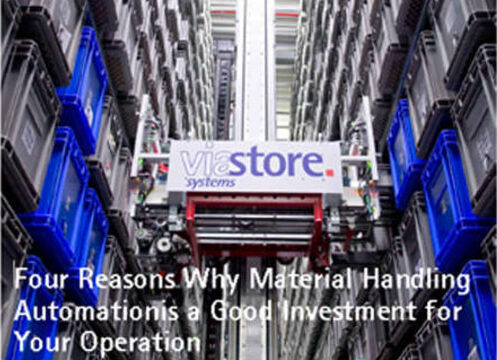
If you currently manage a mostly manual distribution operation, you might assume that material handling automation is out of reach—or simply too expensive for your facility. However, viewing automation as an “all or nothing” concept can cause you to miss out on significant operational gains and rapid return on investment (ROI).
Automated solutions, such as Automated Storage & Retrieval Systems (AS/RS), can be scaled incrementally to target specific areas of your distribution center (DC) that offer the strongest paybacks.
Here are the four primary areas of ROI and key operational benchmarks to consider when evaluating material handling automation.
1. Significant Labor Savings
Rising labor costs and workforce shortages make manual picking and handling increasingly costly. Automation significantly reduces the full-time employee (FTE) headcount required for storage, retrieval, and transport tasks.
- Fewer Operators Needed: A benchmark study comparing AS/RS to manually operated turret trucks in Very Narrow Aisle (VNA) configurations found that while VNA required 16 operators, an AS/RS concept eliminated this operator labor entirely for reserve pallet storage.
- Reduced Supervision & Maintenance: Beyond direct labor, automated systems reduce the time needed for daily supervision and require less overall maintenance compared to traditional heavy equipment.
- Safer Work Environments: In cold storage, freezers, or hazardous environments, automation keeps employees safe by replacing manual labor in harsh conditions.
2. Maximum Space Savings
Expanding physical facility boundaries is often difficult or prohibitively expensive. Automated systems maximize your existing footprint by expanding vertically.
- Smaller Footprint: VNA concept setups can require nearly twice the floor space compared to an AS/RS solution handling the same capacity.
- Building Construction Savings: By utilizing high-density vertical storage, operations can avoid costly building expansions or new warehouse construction.
3. High Throughput and Unmatched System Agility
Modern multichannel fulfillment and e-commerce demands mean handling higher order volumes, more SKUs, and smaller individual order sizes. Manual operations struggle to adapt to these fluctuations without adding labor or costly workarounds.
- Dynamic Capacity Scaling: Unlike manual setups that require scheduling and supervising additional workers during peak periods, an automated system integrated with intelligent Warehouse Management Systems (WMS) or Warehouse Execution Systems (WES) can ramp up crane activity and adjust to work spikes automatically.
- Order Prioritization: Built-in material flow rules allow automated systems (such as mini-load AS/RS) to fast-track hot orders directly to packing or shipping lanes on the fly.
4. Reduced Maintenance, Better Inventory Precision, and Agility
When managing a large number of SKUs, subtle product differences can lead to manual picking errors.
- Real-Time Inventory Control: Automated systems communicate directly with your WCS/WMS platform, offering real-time inventory precision without burdening staff with manual data collection tasks.
- Faster ROI: In comprehensive lifecycle cost comparisons, automated systems often achieve full payback in just over two years while delivering lower overall operating costs.
Fill the form below and access the content for free.
Sponsored By